



















After another blowout win, where does Wake Forest fit in College Football Playoff picture?
The Demon Deacons bullied SMU all game and sent a message to the CFP committee.



Sooner or later, the College Football Playoff selection committee needs to start respecting Wake Forest.


Put the biases aside. Forget history. Just watch the games. Does that look like the 13th best team in the country to you?
Granted, for a variety of reasons, it's hard to tell where Wake Forest exactly fits in the hierarchy of this unpredictable 2026 season. It's not their fault the ACC has become a sad football conference and that there are a bunch of teams that could also be 9-1 with this schedule.

But just look at what this team is doing to opponents lately — if you can stomach the carnage. Every week, Wake Forest shows up to play a football game. And every week, the team they're playing has unwittingly signed up for a humiliation ritual.
Sure, strength of schedule matters. But so does kicking ass — and in a year defined by parity across the country, nobody is doing it as thoroughly as the Demon Deacons.
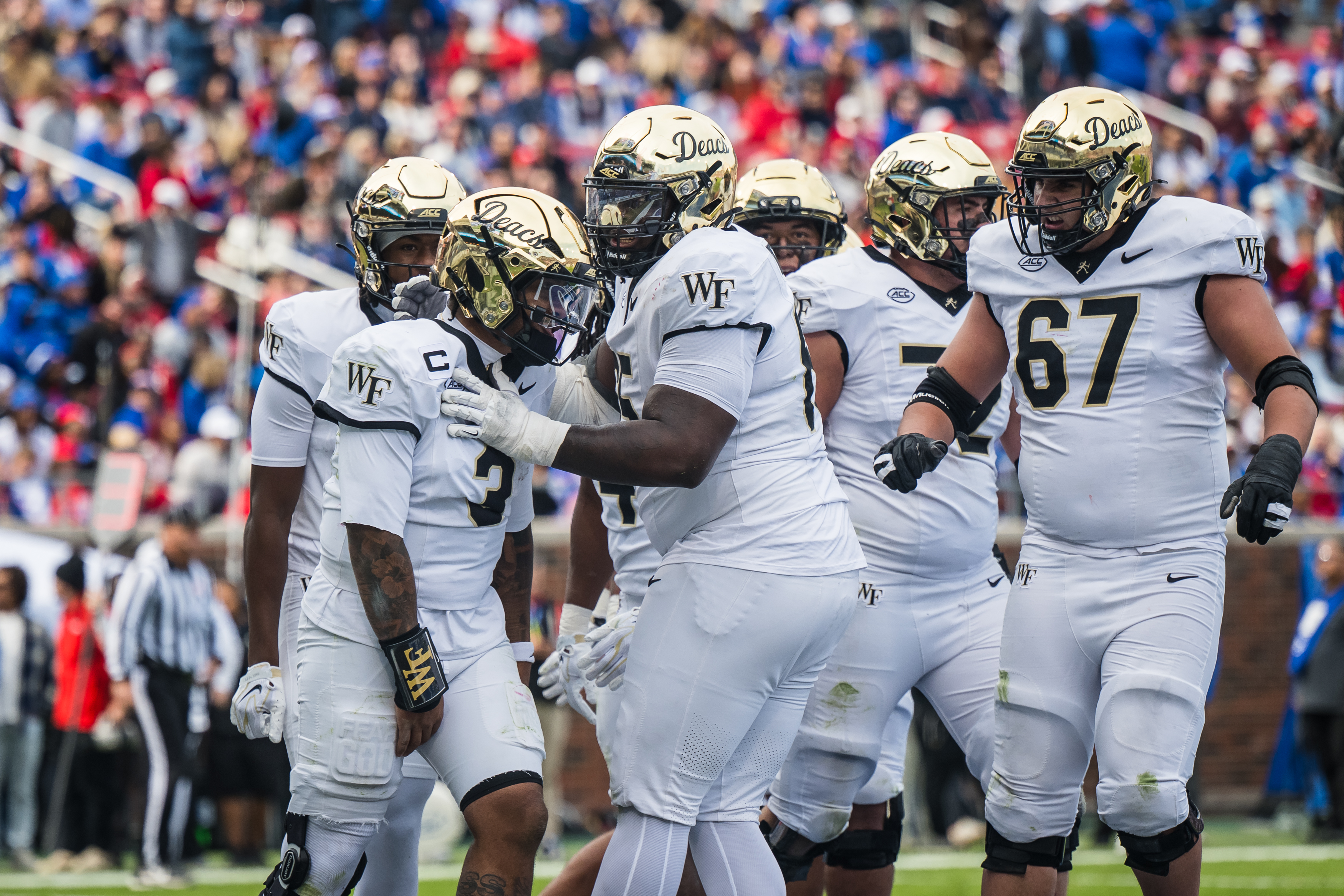
By halftime Saturday in Dallas, Wake Forest had so completely disemboweled SMU that you wonder why anyone — including the Mustangs players — bothered showing up for the second half. At that point, the game was already 42-0 on the way to a 49-7 finish. It might have been the most lopsided game of the year between two pretty good teams.
And yes, SMU was considered a pretty good team at 7-2 before turning into chum for the insatiable sharks wearing gold helmets. But SMU shouldn't feel too bad. Since squeaking by Louisville on Sept. 26, Wake Forest has done this to everyone.
In its last six games, the Deacs have outscored their opponents by a combined 313-38. Sure, there are some results in there that won't move the needle as far as the playoff picture (a 77-0 win over Merrimack in early November is only a statement that Wake Forest should have scheduled better), but 51-7 over Virginia? Beating Stanford 57-3? And then backing it up at SMU with a game that was effectively over well before halftime?
Those aren't great or necessarily even good teams, but Wake is no fluke. We should have already known that back in mid-September when the Demon Deacons suffered their only loss — a very competitive 33-20 decision at Miami. Wake Forest wasn't necessarily close to winning that game, but they looked like they could match up physically — which is crucial, since Miami is the only playoff-caliber team they'll see all year.
Since then, all Wake Forest has done is show time and time again that what happened against Miami was legitimate.
When you are routinely beating conference opponents like this, even in a mediocre conference, it says you belong. And if Wake finishes the regular season at 11-1, which they are very likely to do with games remaining against Georgia Tech and Duke at home, they unequivocally deserve a chance to be in the playoff no matter what happens in a potential ACC championship game rematch with Miami.
But will the committee agree?
So far, they're skeptical. At No. 13 this week, Wake Forest was behind several two-loss teams, including BYU and Kentucky, It's even ranked lower than one-loss Texas Tech, which got destroyed at Cincinnati and subsequently survived fourth quarter battles against Arizona and West Virginia.
It's easy to understand why. This particular committee places a high value on quality wins, and Wake Forest doesn't have one that pops off the page. Nobody is going to say it explicitly, but after years of the SEC complaining about strength of schedule not getting enough credit in the room, it feels like the committee has finally been browbeaten into submission.
Let's say Wake Forest wins its final two games and loses another close one to Miami in the ACC championship game to finish 11-2. It would be a big statement — perhaps even the kind of statement the committee wants to make about scheduling heading into the 24-team era — if Wake Forest got left out under those circumstances.
But it would also be an unfortunate misreading of what the playoff was expanded for in the first place.
Just like Indiana two years ago, which got in at 11-1 without beating a ranked team, it's OK to question if the win-loss record is telling an accurate story about Wake Forest. But that's what the playoff is for, and that's why it expanded a few years ago. With 12 slots available, there has to be enough room in the field for a power conference team that has only lost to a true national title contender and largely dominated everyone else.
If that means a pretty good three-loss SEC team gets left out, too bad. Let Greg Sankey go whine about it on Paul Finebaum's show.
In general, the problem with the committee is that it can't just do one thing or value one metric. The college football season is a big jigsaw puzzle with a bunch of different-sized pieces.
You can't just focus on win-loss records because schedules matter, and they vary wildly from conference to conference, and you'll inevitably end up with teams that don't belong there. But you also can't just focus on strength of schedule because winning games has to matter, too. And you can't just focus on head-to-head because if you apply that principle to every comparison between teams, you'll wind up in a mental pretzel.
The truth is that the committee's job is to pull a little bit on each of those threads and make some very tough decisions. Trotting out these rankings every week when they have a very incomplete set of data sets them up for constant criticism because, inevitably, the logic used to rank one team over another will not apply to a different ranking.
It makes the committee look inconsistent and wishy-washy, but realistically, it makes them normal. Sometimes, the unsatisfactory answer comes down to, "We think Team X has done a better job of navigating its schedule than Team Y." And that's perfectly acceptable when there's no real way to compare two teams that have traveled very different paths. That's what the committee is there for — to process the game like human beings, not computers.
That's also the problem with Wake Forest, though, particularly in a year where there may be a strength-of-schedule backlash brewing in the committee room: There's no other team like them in the country. Because of the week-in, week-out dominance, but also because of a schedule that isn't going to look as good as the playoff contenders in the SEC or Big Ten, they're forcing the committee to guess.
Does their physicality up front, their ballhawking defense and their elite offensive play-calling in ACC games translate to the national championship picture? Ultimately, unless Wake can win an automatic bid with the ACC title, it'll be up to the committee to decide.
So far, it seems they've got plenty of questions about whether this is truly a playoff-worthy team. But every time Wake Forest has played football for nearly two months, they've been screaming the answer.
What's Your Reaction?